Wednesday, March 25, 2026

 Armistead Family History #27

I have to take a few lines here to say I am back to writing my blog again after a few years' absence.  I can't believe I went so long without writing.  I actually had this post ready to go a year and a half ago, except for my references at the end.  Not sure how I managed to go this long without finishing it.  I'm not a professional writer, as you know, but I do spend many hours researching, and I think I got a little burned out.  Trying to do justice to the battles of the Civil War without overwhelming the reader with too many facts (which I love, by the way), but still giving you enough information so you understand what went on, is difficult.  If you have read this blog for a while, you probably have recognized that I have a problem with summarizing things.  I tend to go deep into the weeds. 
So, I hope you enjoy the blog again, and I aim to stay focused and write many more posts.  
Thanks, Moody

1863 - Armistead Family in the Civil War (Part Six)

Battle of Chancellorsville

In my last blog, I wrote about Lawrence Turner Armistead and the fact he was in the hospital at the end of 1863.  I will now go back to the beginning of 1863 and bring you up to date on Thomas Stewart Armistead and Henry Hyer Baker.  These two first cousins started out in 1863 still serving in the Army of Northern Virginia under Robert E Lee.  It won't be long until they are in the thick of battle.      

As I researched and wrote this post, there were times when I needed clarification about what year I was in. I soon realized I created my own confusion when I chose to take Lawrence’s story all the way through 1863 without carrying Thomas and Henry’s story through as well.  So, the result is, we can all be lost together as I write about Thomas and Henry in 1863.

Joseph Hooker. (2024, May 9). In Wikipedia. https://en.wikipedia.org/wiki/Joseph_Hooker

After the devastating loss at Fredericksburg in late 1862, President Lincoln appointed a new general to lead the Union Army, “Fighting Joe” Hooker.  Hooker spent the early part of 1863 replenishing the army with food and munitions.  By April, the Union troops were rejuvenated and once again ready for battle.  Hooker began relocating his troops from his position north of Fredericksburg in anticipation of renewing the continuing struggle with Robert E. Lee.  Lee, meanwhile, had stayed in his highly fortified position at Fredericksburg. 

Hooker ordered his generals to begin the forward movement in early April.  Fate intervened, as it often does in war, and heavy rains descended on the region, delaying the crossing until April 26-28th. Lee’s army, meanwhile, as I mentioned, was well placed with its left flank stretched out to Chancellorsville and its right flank running all the way from Fredericksburg, along the Fredericksburg to Richmond railroad, and then along south of the Rappahannock River.


This map shows movements from April 27 to April 30, 1863.Battle of Chancellorsville. (2024, April 26). In Wikipedia. https://en.wikipedia.org/wiki/Battle_of_Chancellorsville

Hooker’s plan for crushing the Confederates was to cross the Rapidan, slip behind Lee’s forces before Lee could discover his movements, and make adjustments.  At that point, Hooker believed he would be in a position surrounding Lee's left flank, which would allow the Union forces to get between Lee and Richmond, cut off supplies and reinforcements, and enable Hooker to destroy Lee’s army.  (1)

Battle of Chancellorsville. (2024, April 26). In Wikipedia. https://en.wikipedia.org/wiki/Battle_of_Chancellorsville

Hooker's first step in his planned campaign against Lee, to turn his left flank, was to move his men across the Rappahannock and Rapidan Rivers above Fredericksburg.  By crossing the Rapidan by way of Germanna and Ely's Fords he was able to concentrate his forces near Chancellorsville on April 30 and May 1. (2)

Battle of Chancellorsville. (2024, April 26). In Wikipedia. https://en.wikipedia.org/wiki/Battle_of_Chancellorsville

Of Course, Lee had his own plan.  His plan was to circle around his own right flank, Hooker's left flank, which appeared to be “in the air,” and crush the left wing of Hooker's army.  

As it turned out, Lee had to put his plan on hold.  His lookouts observed Hooker's movements, so Lee moved his troops to meet Hooker's advance.  Anderson, McLaws, Rodes, and Wright were ordered forward to meet the Union advance along the Plank Road. This was May 1st.  (Thomas Stewart Armistead was serving in Anderson's Brigade.)  Hooker received reports that his advancing troops were encountering Confederate resistance.  At the same time, he received reports of a large Confederate supporting force moving into position to intercept his attack.  Before he confronted heavy resistance and before the Confederates could force him back, if indeed they would have been able to, Hooker decided to have his troops fall back and concentrate at Chancellorsville. Some historians believe if Hooker had pressed the issue with his large force, he could have barged through the Confederate line because Lee had spread his forces a little thin.  It wouldn't be the last time "Fighting Joe" would not take advantage and attack.  (3)

After the readjustment of part of his army, Lee put a different plan in motion to make a run around Hooker's right flank.  As usual, when Lee had a major plan, he turned to General Jackson to implement the plan.  Jackson's organization and subsequent rapid march by his men to get into position around Hooker's flank took up most of the day on May 2nd.  Finally, at 5:30 pm, Jackson ordered an attack.  Jackson's men made their usual all-out assault on the Union position, initially routing the Union force and causing it to fall back.  However, the Union Generals were able to rally and ultimately mount a counterattack. No real progress was made by either side because it was so late in the day when the initial attack was made, and the attack was through the Wilderness.  Jackson would have continued the attack in other battles, even though the night was falling.  But the Wilderness was a different place altogether.  It consisted of dense, thickly packed masses of trees and vines so concentrated that soldiers stated the Wilderness was nearly pitch black in some areas, even in the daytime, and was extremely difficult to maneuver through.  So darkness settled the issue for the day, and both sides settled in for the night. (4)

The map below shows how the advance unfolded. You can see Jackson's movements, marked in red, on the far left of the map below.  Notice the dotted red line where Jackson altered his direction of attack to make it more of a surprise on the end of Hooker's right flank.  It was a great strategy, but the long distance Jackson's men had to travel contributed to an unsuccessful initial attack.  

Battle of Chancellorsville. (2024, April 26). In Wikipedia. https://en.wikipedia.org/wiki/Battle_of_ChancellorsvilleMap by Hal Jespersen, www.cwmaps.com, CC BY 3.0, https://commons.wikimedia.org/w/index.php?curid=12164445

Jackson was intent on pressing the issue against these Union forces that stood between him and his mission to crush Hooker's flank. He sent orders to his commanders to be ready to take up the battle again on the 3rd, as soon as it was daylight.  In preparation for the morning attack, Jackson traveled beyond his front lines and even the picket lines to search for a better location to attack the Union position.  He rode into the dark night with his aides to scout out the best route possible that would enable him to flank the Union lines and deliver a crushing blow.  He rode close enough to hear the Union axes hard at work on building a defensive position and located the route he wanted to take.  He now had his plan firmly in mind.  He turned back toward his own lines. As he approached his own picket lines, a North Carolina unit mistook his party for Union Cavalry.  They opened fire.  Before the pickets could be made to understand they were firing at their own men, and order could be restored, numerous dead horses and officers lay on the ground.  Jackson himself was shot in the upper left arm and through his hand.  Jackson stayed in the saddle but was losing blood from a severed artery and was in shock.  His aides had to lift Jackson from the saddle.  He was laid under a tree, and a surgeon was summoned.  The surgeon determined Jackson's arm would have to be amputated and ordered Jackson to be removed from the field and carried by wagon to the rear.  It was a long and torturous ride.  Every time the wagon wheel fell into a hole, Jackson was jolted hard and felt great pain. (5) I can not imagine what terrible pain he must have suffered through.

Stonewall Jackson photo    By Unknown author - Derivative (crop) of: File: Photograph of General Thomas J. "Stonewall" Jackson - NARA - 526067.tif, Public Domain, https://commons.wikimedia.org/w/index.php?curid=4949147

By Unknown author - Derivative (crop) of: File: Photograph of General Thomas J. "Stonewall" Jackson - NARA - 526067.tif, Public Domain, https://commons.wikimedia.org/w/index.php?curid=4949147   Battle of Chancellorsville. (2024, April 26). In Wikipedia. https://en.wikipedia.org/wiki/Battle_of_Chancellorsville

Finally arriving at the field hospital, a surgeon had time to evaluate Jackson's left arm.  There was nothing he could do but amputate because that was all that could be done at this time in history to prevent infection and gangrene in the badly damaged arm.  

Even after Jackson's terrible ride to the hospital in the rear and the amputation, the doctor's prognosis was good.  Jackson seemed to be getting better for a while.  But after a few days, he developed a fever and was restless.  The attending doctor determined Jackson had developed pneumonia.  In those days, that was a death sentence; nothing could be done but keep him comfortable.  Jackson's second wife, Mary Anna (Morrison) Jackson, made it to Jackson's side soon after he reached the hospital.  She was with him as he had gotten better.  But now all she could do was be by his side, comfort him, and pray. (6) 

A longer, more detailed account of Jackson's last days can be found in numerous books for all you military historians out there.  Jackson's death would have a significant effect on Lee's ability to win going forward.

When Lee received the news of Jackson's wounding, he, as did the doctors, believed Jackson would recover.  Many officers continued to serve with a missing arm or leg. Lee was, of course, worried about pressing the battle without Jackson, but not about Jackson dying.  Lee ordered General Jeb Stuart to lead Jackson's men into battle the next morning.  His order read: "The glorious victory thus far achieved must be prosecuted with the utmost vigor, and the enemy given no time to rally..." (7)

On May 3rd, the Confederates attacked on both flanks of Hooker's army.  This broke the Union line at Chancellorsville.  Hooker withdrew back to the river and set up in a defensive position.  Hooker summoned his Generals to vote on pressing the issue.  His generals voted to attack.  Hooker decided to withdraw.  On May 5-6, Hooker crossed back over the Rappahannock.  Just a few days before, he had crossed the river with a glorious plan and much bluster to his officers that he would crush Lee.  Now he had, for some reason, lost his optimism and retreated.  He was no longer "Fighting Joe" Hooker.  

By Map by Hal Jespersen, www.cwmaps.com, CC BY 3.0, https://commons.wikimedia.org/w/index.php?curid=12164455   Battle of Chancellorsville. (2024, April 26). In Wikipedia. https://en.wikipedia.org/wiki/Battle_of_Chancellorsville


Map by Hal Jespersen, www.cwmaps.com, CC BY 3.0, https://commons.wikimedia.org/w/index.php?curid=12164462   Battle of Chancellorsville. (2024, April 26). In Wikipedia. https://en.wikipedia.org/wiki/Battle_of_Chancellorsville

Some historians proclaim this as Lee's greatest victory. Still, Lee knew he could not win the war with a continuation of Confederate losses like he suffered here and at Antietam/Sharpsburg.  In addition, the loss of Jackson left him without his trusted General who had delivered many victories for the Confederate army.

Map by Hal Jespersen, www.cwmaps.com, CC BY 3.0, https://commons.wikimedia.org/w/index.php?curid=12164469   Battle of Chancellorsville. (2024, April 26). In Wikipedia. https://en.wikipedia.org/ Chancellorsville 

I only included some of the descriptions of this battle and a short version of the death of General Stonewall Jackson.  This battle raged for several days.  Indeed, one day of the fighting was particularly brutal, with the number of casualties on that one day being second only to Antietam.  The battle included numerous movements of troops, confrontations, clashes of hand-to-hand combat, and stories like that of Jackson.  General Hooker himself has a story.  At one point during the Confederate Army's routing of the Union on May 3rd, Hooker, leaning against a column at the Chancellor's home (Hooker's headquarters), gave his orders to an aide just as a Confederate shell hit and splintered the column next to him.  The force of the blast not only knocked Hooker down but also knocked him unconscious.  He was out for thirty minutes, and it took him hours to fully come to his senses again.  (8)

The Battle of Chancellorsville had a huge impact on the war.  With the loss of Jackson, Lee had lost what he termed "his right arm".  Jackson was a key strategic general and had consistently put together superior plans of attack against the opposing forces.  His men were known as being fierce and fearless in battle, and the loud whoop of their combined voices doing the Rebel yell when they were attacking was terrifying to many men on the other side.  The Battle of Chancellorsville, fought over three days, had 13,460 casualties for the Confederates.  This continued the huge loss of men in battle.  Although the Union Army had 17,304 casualties, Lee knew he could not sustain a viable army with the continuing losses he was taking.  The Union side had lost more men, but they had a much larger pool to draw from.  These two happenings, the loss of Jackson and the continued loss of huge numbers of men, would have a debilitating impact on Lee and his ability to continue with his drive to take the battle to the Union on its own soil in the north. (9)

Lt. Thomas Stewart Armistead, my great-granduncle, was injured in the leg on May 3rd and was counted among the more than 13,000 casualties. I haven't been able to determine how long Thomas was out of action, but it looks like he was out until at least the end of August 1863.  I do have the document showing he was moved to the hospital and that he was absent on May 12, the date of the document.


Page 6 of a 24-page record for Thomas Stewart Armistead in Fold 3.


Page 7 of a 24-page record for Thomas Stewart Armistead in Fold 3.

Fold3, US, Compiled Service Records of Confederate Soldiers Who Served in Organizations from the State of Florida, 1861-1865 (https://www.fold3.com/publication/30/us-civil-war-service-records-cmsr-confederate-florida-1861-1865: accessed May 28, 2024), database and images, https://www.fold3.com/publication/30/us-civil-war-service-records-cmsr-confederate-florida-1861-1865

In the document above, you see 
Thomas Armistead is in the hospital from April 30, 1863, to Aug 31, 1863. Obviously, the leg wound was serious.  A bullet or piece of shrapnel can cause a lot of damage.

And so the war grinds on. After each battle, the two armies regroup and prepare as best they can for the next strategic move they will attempt to make.  Each side will try to gain an advantage and strike the other side from a position of strength, believing that this time they would be able to deal the final blow that would end the war.  

I will continue the story of the Armisteads in the next blog.  The Armistead family is running out of sons to sacrifice or have injured in this horrible, crushing war!  Their cousin, Henry Hyer Baker, survives Chancellorsville, as did another, more distant cousin, Lewis Addison Armistead.  Gettysburg is down the road.  Thomas will be in the hospital during this battle, but what fate awaits Henry and L.A.?

References:

1) Foote, Shelby, The Civil War, A Narrative, Fredericksburg to Meridian, Random House, New York, Copyright 1963, pg 263
2) Ibid. Foote, pg 271
3) Ibid. Foote, pg 274
4) Ibid. Foote, pg 292-300
5) Ibid. Foote, pg 300-303
6) Ibid. Foote, pg 317-319
7Ibid. Foote, pg 303
8Ibid. Foote, pg 304
9) Ibid. Foote, pg 314-315


Monday, April 17, 2023

 Armistead Family History #26


1863 - Armistead Family in the Civil War (Part Five)

Moving from the death and destruction of 1862 and straight into 1863 the Civil War, a war that both sides believed would last no more than six weeks, begins year three.  What will the Armistead family have to face during this year?  

In the year 1863, the war would produce more and more bloody battles.  Seemingly every battle was more terrible than the last.  Casualty counts just continued to escalate as both sides became more adept at killing their enemy and each side dug in for a continued long haul, despite all the tragic losses.

Civil War Saga lists 23 battles in 1863, with a total of 206,488 casualties.  In addition to this number, there were numerous other small battles and skirmishes. Two battles during this year will account for the two biggest battles with the highest casualties during the war.  (1)

In January 1863 President Lincoln officially published the Emancipation Proclamation that he wrote and presented to his cabinet after the Battle of Antietam. Through this act, he freed the slaves in the seceded states. (2)

In March 1863 President Lincoln, in response to the need for additional soldiers, signed a federal draft act. The Conscription Act of 1863 established the first national draft system and required registration by every male citizen. (3)  

At the opening of 1863, Lawrence T. Armistead was serving in Braxton Bragg's Army of Tennesee. While in winter quarters they re-supplied their munitions, food, and men. But as January opened they were quickly on the move again fighting minor battles (as if any battle was really minor) in Tennessee and Kentucky at Murfreesboro, (January) Lexington, (May) Knoxville, (June) Tullahoma, (July). (4)

 
Tullahoma Campaign, June 24 - July 3, 1863.  Hal Jespersen, 14 July 2008.   By Map by Hal Jespersen, www.posix.com/CW, CC BY 3.0, https://commons.wikimedia.org/w/index.php?curid=9064219

So the last battle I listed above, the Battle of Tullahoma is shown on the map.  The fighting occurred between June 24th and July 3rd.  The map shows how the battle finally ended up with the Rebels in Chattanooga and the Union army just outside.

During this campaign from January to July, Sgt. Lawrence T. Armistead on April 14, 1863, was elected by the men in his company to serve as his company's 2nd Lieutenant. (5) I probably don't have to mention the fate of his brother after being elected to the position of Lieutenant.  I do find it interesting that these brothers, Lawrence, Anthony, and Thomas, (as well as their first cousin, Henry Hyer Baker) were all elected to serve as leaders for their respective companies. Of course, Lawrence may have had the best preparation for being an officer because he attended West Point not many years before.  Lawrence obviously made an impression on these men with his leadership ability.  The vote was 32 for Lawrence and 18 and 9 for the other two candidates. You can see the results below.

Source Citation:
National Archives and Records Administration (NARA); Washington, D.C.; Compiled Service Records of Confederate Soldiers Who Served in Organizations from the State of Florida; Series Number: M251; Roll: 25
Source Information:
Ancestry.com. U.S., Confederate Soldiers Compiled Service Records, 1861-1865 [database on-line]. Lehi, UT, USA: Ancestry.com Operations, Inc., 2011. U.S., Confederate Soldiers Compiled Service Records, 1861-1865 provided by Fold3 © Copyright 2011 Intellectual Reserve, Inc. All rights reserved. All use is subject to the limited use license and other terms and conditions applicable to this site.
Original data: View Sources. Description:
This database contains an index to compiled service records (CSRs) for soldiers who served with units in the Confederate army. Most of the men whose names appear in this index served with units from 15 different states or territories; others were soldiers raised directly by the Confederate government, generals and staff officers, and other enlisted men not associated with a regiment

All the confrontations that ended up with casualties were of course consequential to those involved.  However, the 6th Florida Infantry's first really major battle of the year came in September, one year after Anthony lost his life in the Battle of Antietam.  The battle was fought along the Chickamauga River and of course, was called the Battle of Chickamauga.  Lawrence's future would be greatly changed in this battle.

In September the Army of Tennessee was in control of Chattanooga.  The Union forces, just to the north of the city, were led by General William Rosecrans and Major General George H. Thomas.  Both sides were keenly aware of the importance of Chatanooga.  The city was located on the Tennessee River and was home to the crossroads of four major railroads.  It was a vital supply chain link to all of the South.  If the North could take control of this area they could severely damage the South's supply lines and contribute to ending the war faster. (6)

By Map by Hal Jespersen, www.posix.com/CW, CC BY 3.0, https://commons.wikimedia.org/w/index.php?curid=9063983

General Rosecrans mounted an assault on the rebels in Chattanooga and was able to force them out of the city and push them southeast into Georgia.  General Bragg retreated to the area around the Chickamauga River.  Once there, He quickly formulated a plan whereby he would turn the tables and attack the Union Army.  Bragg would ask for reinforcements and then counterattack Rosecrans, drive his army back, and recapture Chatanooga.  Southern President Davis ordered General Longstreet to join Bragg to beef up his command.  General Rosecrans had about 60,000 troops and with the addition of Longstreet's men Bragg's numbers would increase to 65,000 men. (7)  

With Rosecrans's army in position to the northwest of the river, General Bragg set in motion his plan to concentrate a counter-attack on one area (his left flank and Rosecrans's right flank) of Rosecrans's army.  If he could crush it, and drive it back into the right flank of Rosecrans he could throw that area into confusion and execute his "meat grinder operation."  I'll let Shelby Foote explain it better.  "Bragg massed his army before nightfall on the east side of Chickamauga Creek, his left at Glass's Mill, a mile above (that is south of) Lee & Gordons, and his right near Reeds's Bridge, five miles downstream... Polk would demonstrate on the left, fixing Crittenden in position, while Buckner and Walker - supported by Hood who was scheduled to arrive in the course of the day - crossed by fords and bridges, well below, with instructions to... 'sweep up the Chickamauga, toward Lee & Gordons's Mill.'  As they approached that point, Polk was to force a crossing and assist in driving the outflanked bluecoats towards McLemore's Cove for another try at the "meat grinder" operation. (Hood was) ...charged with executing the gatelike swing that was designed to throw Crittenden into retreat by bringing them down hard on his flank and rear.  Meanwhile, opposite Glass's Mill, Hill would hold the pivot and stand ready to strike at any reinforcements from Thomas, moving north from Pond Spring toward the mouth of the cove and packing them back into the grinder.  The attack was to open in the far right at Reed's Bridge, and the jump-off hour was set for sunrise." (8) 

The ultimate goal was, of course, to drive the Union Army back in panic and confusion so that the Southern Army could drive them from the area and re-take control of Chatanooga.

Chickamauga Campaign, Sep. 18, 1863.  Hal Jespersen, 1 Dec 2008.
https://commons.wikimedia.org/w/index.php?curid=9063955

So just a quick note.  I know if you are not interested in Civil War Battles you will struggle to follow Bragg's plans as outlined by Foote.  I had to read many times and follow along on the maps to finally make sense of the plan.  The map above shows the armies' positions on Sep. 18th and should help understand the plan.

Minor skirmishing occurred in the days leading up to the major battle.  The heavy fighting started on Sep 19th. General Bragg hit the left of Rosecrans's position as he had planned. However, heavy fighting all day did not break Rosecrans's line as he had envisioned. You can follow the long day of fighting that took place.  Below are the maps for the morning, early afternoon, and late afternoon.  The fighting was ferocious with lots of casualties but nothing changed in the two armies' positions. I boiled it down to a short paragraph but in actuality, there was a lot of maneuvering that went on by both armies. I'm not going into a deep analysis of the battle but that does not mean it was not an important battle.  It was important and you will see that as we go along.

Lawrence and the 6th Florida were in the reserve corps most of the first day but were thrust into action about mid-afternoon when they were ordered to charge a Federal battery of artillery.  Despite being close enough to an enemy battery on its left that it was enfiladed by canister and grapeshot, the regiment carried the position and the battery in front retreated.  It was now about sundown and the darkness finally ended the fighting for the day. (9)  


By Map by Hal Jespersen, www.posix.com/CW, CC BY 3.0, 
https://commons.wikimedia.org/w/index.php?curid=9063956

By Map by Hal Jespersen, www.posix.com/CW, CC BY 3.0, https://commons.wikimedia.org/w/index.php?curid=9063983

By Map by Hal Jespersen, www.posix.com/CW, CC BY 3.0, https://commons.wikimedia.org/w/index.php?curid=9063961

In his book, The Chickamauga Campaign: Glory or the Grave, David A. Powell, states this about the first day and night.  "In addition to all the formal troop movements planned and executed during those dark hours, the battlefield seethed with other activity.  All day long aid parties in both blue and gray had struggled to bring off non-ambulatory wounded and deposit them in the nearest field hospital.  That laborious and heartbreaking work was nowhere near finished by the time night settled over the field.  The battlefield was still carpeted with thousands of pleading injured-shouting, whispering, or waving for help of any kind.  John Glenn of the 27th Illinois, Bradley's Brigade" was on the field.  '[W]e remained all night on the ground when we quit fighting, among the dead and wounded for both armies,'  he wrote.  '...Anyone who has seen a battlefield will never care to see another.'  Sergeant Benjamin F Magee of the 72nd Indiana, part of John Wilder's brigade, was not too far from John Glenn that night.  The Hoosier listened to the plaintive wail of an unidentified wounded man who pleaded, 'O, for God's sake come and help me!'  The repeated pleas rattled a few men who finally decided to try and find the stricken soldier.  Picket fire from the Rebels, however, quickly discouraged that idea and the men returned to their lines.  The man's cry grew fainter each time it was uttered until it eventually faded away." (10)

On Sep 20th, General Bragg ordered General Longstreet's newly arrived reinforcements into the attack.  Now having superior numbers, Bragg tried his original plan once again.  On the Union side, General Rosecrans received critical intelligence from his scouts.  They reported to him that he had a gap in his lines.  Rosecrans moved units of his army around to fill the gap that had been reported to him.  Unfortunately, the intel was incorrect.  In the process of making moves to fill the gap he actually created a gap.  Longstreet recognized this error immediately and quickly exploited the situation.  Driving his forces through the gap in Union lines, Longstreet was able to rout a third of the Union forces.  With a third of his army in headlong retreat, Rosecrans seemed to be un-nerved right along with his men who were racing north toward Rossville leaving the area to the Confederates.  If the rest of the army had followed these panicked troops north the South might have been able to crush Rosecrans's entire army.  This would have had far-reaching effects and would have done tremendous harm to the North's cause. (11)

Rosecrans, and his chief aide, James A. Garfield did attempt to stem the flow of the retreating men but without success.  They then attempted to find General Thomas at his last known position but were unsuccessful in that as well.  Garfield reminded Rosecrans he was the commander and he needed to leave for Chattanooga and he did just that, following his panicked men all the way to Chattanooga.  Garfield went in Rosecrans's place to find Thomas.  After hours of riding in very dangerous conditions that ended with the death of both his orderlies and serious wounds to himself, Garfield found Thomas at about 4:00 pm.  His action, dubbed "Garfields Ride", was seen as a heroic action "that would propel him into the presidency in 1880." (12)  Unfortunately for Garfield’s presidency he was assassinated a little over six months after taking office.

Battle of Chickamauga.   By Kurz & Allison - Library of Congress, Public Domain, https://commons.wikimedia.org/w/index.php?curid=1484303

With the information from Garfield that there would be no reinforcements, Major General George H. Thomas recognized the imminent danger of a complete rout. He took action by taking command of the Union forces left on the field.  He began directing the remaining units to consolidate into a defensive potion where they could attempt to hold the surging Rebel forces at bay. They were severely outnumbered but Thomas was able to just barely hold on to his position until dark.  The fall of darkness afforded Thomas the cover he needed to organize an orderly retreat from the field, leaving the field to the Confederates.  Major General Thomas was described as "standing like a rock" in holding back the Confederate attacks and preventing a complete catastrophe. This quote soon earned him the nickname "The Rock of Chickamauga".  In the coming weeks, he would also be rewarded with a promotion. (13)


General George Henry Thomas, By Mathew Benjamin Brady - This image is available from the United States Library of Congress's Prints and Photographs division under the digital ID cwpbh.01069.This tag does not indicate the copyright status of the attached work. A normal copyright tag is still required. See Commons: Licensing for more information., Public Domain, https://commons.wikimedia.org/w/index.php?curid=1355381


By Map by Hal Jespersen, www.posix.com/CW, CC BY 3.0, https://commons.wikimedia.org/w/index.php?curid=9063972                                


By Map by Hal Jespersen, www.posix.com/CW, CC BY 3.0, https://commons.wikimedia.org/w/index.php?curid=9063969

For Lawrence's part in the days fighting he and the 6th of Florida, and the 54th of Virginia were ordered to support a battalion of Confederate artillery. Shortly, however, they were ordered to their right to reinforce General Patton Anderson and General Kelly.  General Anderson gave them their proper alignment and sent them forward.  The two regiments eventually cleared the heights of Chickamauga and took about 500 enemy soldiers as prisoners of war.  Darkness again ended the fighting on the second day which also turned out to be the end of the battle.  

As usual, after the battle, there were recriminations on both sides.  Much criticism was directed at Bragg for not following quickly against the Union army to attempt to follow it and further crush it, and of course, Rosecrans was criticized for retreating instead of rallying his men.  Chickamauga was a huge win for the South. However, as a result of Bragg’s lack of action to force the issue, he was removed from his position as commander of the Army of the Cumberland. (14)


General William Rosecrans,  By Brady National Photographic Art Gallery - This image is available from the United States Library of Congress's Prints and Photographs division under the digital ID cwpb.06052.This tag does not indicate the copyright status of the attached work. A normal copyright tag is still required. See Commons: Licensing for more information., Public Domain, https://commons.wikimedia.org/w/index.php?curid=3096401

The result of the battle left 8,000 Union soldiers captured along with 51 guns, 23,281 small arms, 2,381 rounds of artillery ammunition and 135,000 rifle cartridges of the Union, and large quantities of wagons, ambulances, and teams, medicines, hospital stores, etc. The human toll was 16,170 Union casualties and 18,454 Confederate. (15)

One of the 36,624 casualties was my great grand-uncle, Lawrence T. Armistead.  He was shot or hit by shrapnel in the wrist.  He was taken to a hospital in Macon, Georgia where he remained for weeks. I don't know but I am guessing his wrist was shattered.  Think about a bullet hitting your wrist.  Not much there but bone!  Tens of thousands of soldiers that suffered wounds to their limbs ended up with amputations. I have not seen anything that indicated that was the case with Lawrence but from the duration of time he spent in the hospital, I'd say it was very serious.  After a long hospital stay, (records show he was hospitalized in November and December) he was furloughed from the hospital on Jan 6, 1864.  No mention of a specific length of time for the furlough, the record just said he was furloughed. In examining the records for 1864 there were mentions of him being sick and he was still receiving his lieutenant's pay during the year, but he was not on the active roster as far as I could tell.  Don't worry, we have not heard the last of Lt. L.T. Armistead.  His story picks up again in September 1864.


The two records above state that Lawrence was wounded and was admitted to the *Ocmulgee Hospital on Oct 4th. Then it shows he was in the hospital during November and December 1863.


All the Military Records above came from this source:  
Source Information: National Park Service. U.S., Civil War Soldiers, 1861-1865 [database online]. Provo, UT, USA: Ancestry.com Operations Inc, 2007.
Original data: National Park Service, Civil War Soldiers, and Sailors System, online <http://www.itd.nps.gov/cwss/>, acquired 2007.
Description: This database contains the names of approximately 6.3 million soldiers who served in the American Civil War. In addition to their names, information that may be listed for each soldier includes regiment, company, and rank.

The first record above shows he was furloughed on Jan. 8, 1864, and apparently still on furlough as of the end of Feb. 1864.  Then a report on Aug 18th shows he was sick on July 22, 1864, and then again admitted to the hospital on July 24th for treatment of diarrhea, and was transferred out on July 24th.  Where was he transferred?  Back to his company? To another hospital or to his home?  I don't know. The last record shows he was sick as of Aug 28th. 

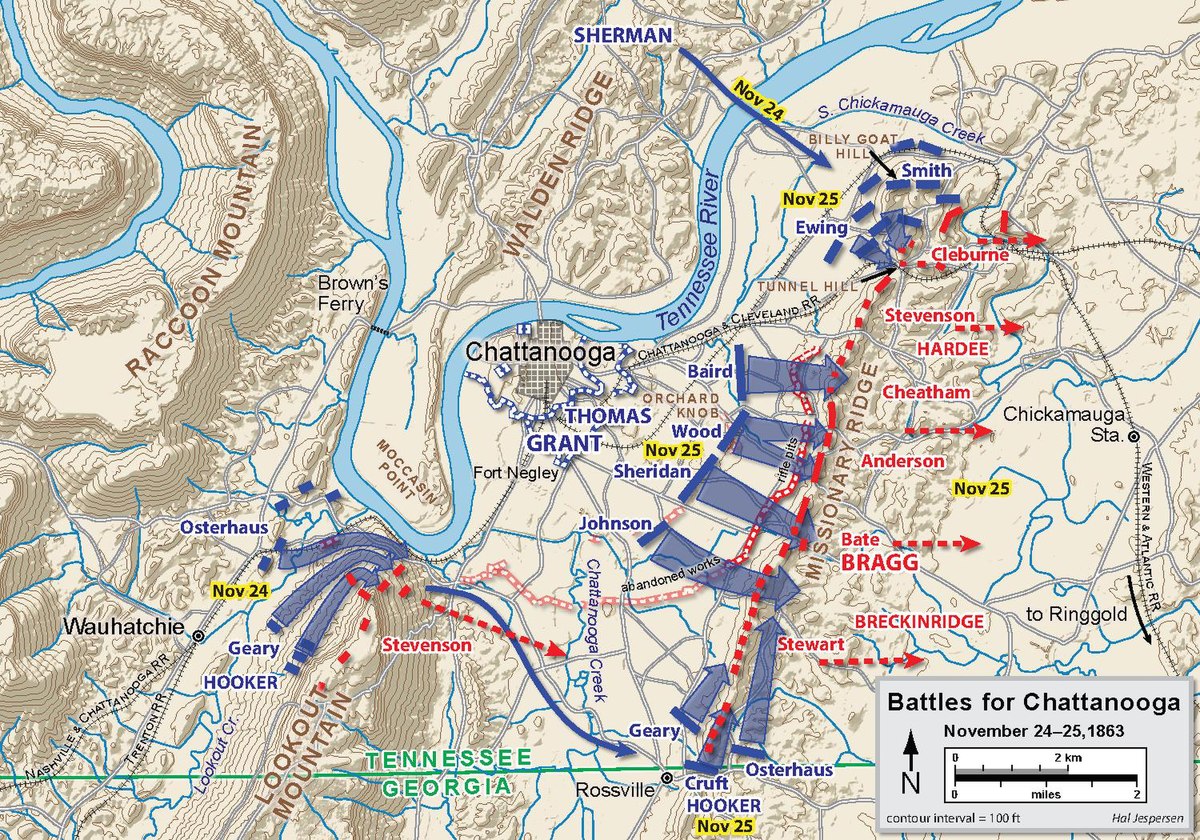
The battles for Chattanooga, November 24–25, 1863, were the culmination of the Chattanooga campaign of the American Civil War.  24 Dec 2022, by Hal Jesperson.  https://commons.wikimedia.org/wiki/File:Chattanooga_Campaign_Battles_November_24-25.pdf 

The Confederate Army of Tennessee spent a day re-supplying, re-organizing etc. before they set off after Rosecrans.  Rosecrans ended up in Chattanooga and Bragg occupied the heights of Missionary Ridge.  (See the map above.)  

The Battle of Chickamauga was the second bloodiest battle of the Civil War. Gettysburg had the highest number of casualties. (It was fought earlier in the year in July.  I will cover that battle in my next post.)  It was contested over three days whereas Chickamauga was a two-day battle.  (Remember Antietam was the bloodiest single-day battle.)  

The Confederate siege of Chatanooga continued until October when General Ulysses S. Grant arrived with reinforcements from his campaign along the Mississippi.  Grant was given the command of the Union army in the region.  Major General Thomas was promoted to Brigadier General for his efforts at Chickamauga and was given command of the Army of the Cumberland, replacing Rosecrans.  In November Grant's forces reversed the loss at Chickamauga by leading a decisive victory over the Confederates in the Battle of Chattanooga on Nov. 23-25.  This convincing victory drove the Confederate army from the area and the North gained permanent control of the city with the advantage of controlling supply lines that the South desperately needed.  This basically reversed their loss at Chickamauga and turned the entire campaign into a victory for the North. (16)

Next post I'll go back and cover my great-granduncle, Thomas Stewart Armistead, and his first cousin, Henry Hyer Baker during the year 1863 and their participation in the bloodiest battle of the war at Gettysburg.

*The Ocmulgee Hospital in Macon Georgia was one of several locations where wounded soldiers were brought for treatment.  Dr. James Mercer Green used his own home for patients, The Floyd House, a converted hotel, was used as well as the Georgia Academy for the Blind.  In April 1862 fifteen train carloads of wounded soldiers arrived from the Battle of Shiloh and overwhelmed the city.  The citizens rallied to the need for provisions as well as attendants.  By the next year when hundreds of wounded soldiers from the Battle of Chickamauga were sent to Macon, the citizens would have to mobilize again.  This happened each time a major battle was fought in Georgia. You can read more on the internet about the city's efforts to care for the wounded. Dr. Green's house and historical marker are below.


From HMDB.org website.  Tells the story of Dr. Green and the hospitals involved in Macon, GA.   https://www.hmdb.org/m.asp?m=186792  It's an interesting read. Hop over to the website and take a look. (HMDB stands for Historical Marker Data Base.)

References:

1) Civil War Battles-Civil War Sagas  (https://civilwarsaga.com/civil-war-battles/
2) Timeline of the Civil War - Civil War Saga (https://civilwarsage.com/timeline-of-the-civil-war/)
3) Timeline of the Civil War - Civil War Saga  (https://civilwarsage.com/timeline-of-the-civil-war/)
4) Source Information:  National Park Service. U.S., Civil War Soldiers, 1861-1865 [database online]. Provo, UT, USA: Ancestry.com Operations Inc, 2007.   
Original data: National Park Service, Civil War Soldiers, and Sailors System, online <http://www.itd.nps.gov/cwss/>, acquired 2007.
Description:  This database contains the names of approximately 6.3 million soldiers who served in the American Civil War. In addition to their names, information that may be listed for each soldier includes regiment, company, and rank 
5) Source Information:  National Park Service. U.S., Civil War Soldiers, 1861-1865 [database online]. Provo, UT, USA: Ancestry.com Operations Inc, 2007.
Original data: National Park Service, Civil War Soldiers, and Sailors System, online <http://www.itd.nps.gov/cwss/>, acquired 2007.
Description:  This database contains the names of approximately 6.3 million soldiers who served in the American Civil War. In addition to their names, information that may be listed for each soldier includes regiment, company, and rank 
6) Foote, Shelby, The Civil War, A Narrative, Fredericksburg to Meridian, Random House, New York, Copyright 1958, pg 
7) Ibid. Foote, pg 713
8) Ibid. Foote, pg 715
9) Source Information:  National Park Service. U.S., Civil War Soldiers, 1861-1865 [database online]. Provo, UT, USA: Ancestry.com Operations Inc, 2007.
Original data: National Park Service, Civil War Soldiers, and Sailors System, online <http://www.itd.nps.gov/cwss/>, acquired 2007.
Description:  This database contains the names of approximately 6.3 million soldiers who served in the American Civil War. In addition to their names, information that may be listed for each soldier includes regiment, company, and rank 
10) Powell, David A, The Chickamauga Campaign: Glory or the Grave, David A. Powell, Savas Beatie, California, copyright 2015, pg 604.
11) Ibid. Foote, pg 736
12) Captivating History, The Battle of Chickamauga, A Captivating Guide to the Biggest Battle Ever Fought in Georgia and its Impact on the American Civil War, pg 54. 
13) Ibid, Captivating History, pg 54
14) https://www.history.com/topics/american-civil-war/battle-of-chickamauga
15) Ibid. Foote, pg 756
16) https://www.battlefields.org/learn/civil-war/battles/chickamauga


Monday, June 20, 2022

Armistead Family History #25

1862 - Armistead Family in the Civil War (part four)

Battle Aftermath

Read Shelby Foote's words from The Civil War, A Narrative, regarding the immediate aftermath of The Battle of Antietam/Sharpsburg,   

"And now in the sunset, here on the right, as previously on the left and along the center, the conflict ended; except that this time it was for good.  Twilight came down and the landscape was dotted with burning haystacks, set afire by bursting shells.  For a time the cries of wounded men of both armies came from these;  they crawled up into the hay for shelter but now, bled too weak to crawl back out again were roasted.  Lee's line was intact along the Sharpsburg ridge.  McClellan had failed to break it; or, breaking it had failed in all three cases, left and center and right, to supply the extra push that would keep it broken." (1)

With General Lee withdrawing his army and McClellan choosing not to pursue, the Union Army was left to bury the dead and treat the wounded.  This was an unusual turn of events because up until now the Union had mostly been the army that had withdrawn from the field first. 

As a precaution, I will warn you that these photographs of dead bodies are disturbing to look at. Feel free to quickly scroll through these to other sections of the blog.

Bodies lined up to be buried.
https://i.pinimg.com/600x315/39/f7/cc/39f7cc319235bae8c3d1c6c3e7ecf9c1.jpg

Buring the dead.  
https://external-preview.redd.it/oVSwGeFM-GOHybFfrunAYGlZc0AD-Vxa7GfNmDMOhBA.gif?format=png8&s=026706941095722b13ebc57c2533d9701b7c5145

Soldiers that died near Dunkard Church prepared for burial.
https://www.bing.com/images/search?view=detailV2&ccid=jdqI7CTV&id=767A3C29D834E0FEEB14416119F83B7C480B0DAC&thid=OIP.jdqI7CTVkEInCSnrKWvT9QHaF8&mediaurl=https%3A%2F%2Ffthmb.tqn.com%2FM2UsPo12THbLY05CocNKcajUzR4%3D%2F768x0%2Ffilters%3Ano_upscale()%3Amax_bytes(150000)%3Astrip_icc()%2Fangard-dunker01-58b98afc3df78c353ce261a0.jpg&exph=617&expw=768&q=Antietam+Dead&simid=607998654521559302&form=IRPRST&ck=EDB8C444D4D9BF7387F88728B1865A08&selectedindex=36&ajaxhist=0&ajaxserp=0&vt=0&sim=11&cdnurl=https%3A%2F%2Fth.bing.com%2Fth%2Fid%2FR.8dda88ec24d59042270929eb296bd3f5%3Frik%3DrA0LSHw7%252bBlhQQ%26pid%3DImgRaw%26r%3D0

Buring the dead was a huge undertaking.  This massive "three battles in one" confrontation of over 100,000 men produced these staggering numbers: "Nearly 11,000 (10,316) Confederates and more than 12,000 (12,401) Federals had fallen along that ridge and in that valley including a toll on both sides of about 5,000 dead."  At the aptly named Bloody Lane alone there were 5,935 casualties. the Union had 3,361 and the Confederates suffered 2,574 at that spot alone. (2)


The Bloody Lane, September 19, 1862, after most of the bodies, had been removed from the Bloody Lane and buried.
By Alexander Gardner - File from The Photographic History of The Civil War in Ten Volumes: Volume Two, Two Years of Grim War. The Review of Reviews Co., New York. 1911. p. 74., Public Domain, https://commons.wikimedia.org/w/index.php?curid=7331373

Anthony Armistead Died at The Battle of Sharpsburg.


Somewhere on the open field where the 8th Florida Infantry charged across to reinforce the men in the Bloody Lane or somewhere around or in the Bloody Lane itself, lay the body of Lieutenant Anthony Armistead. Now buried somewhere on that field of battle, we may never know exactly where he died.  Anthony was killed on Wednesday, September 17, 1862. (3)

I think his brother, Thomas, knew his brother had fallen.  They were lieutenants of the same company and most likely were in front leading their men.  He may have seen Anthony go down and paused to try to help and seeing there was nothing to do that would help him, or doing what he could to comfort him, continued on the run toward the Sunken Road.  If he did not see him go down he would not have known until that night when the officers tried to account for their men that his brother had been a casualty.  It is possible that he may have thought his brother had been wounded and captured. Because the Confederates pulled out overnight it seems reasonable that Thomas never saw his older brother again after they took off on the attack at the Bloody Lane and very likely he did not have a chance to tend to Anthony's body or to tell his brother goodbye.  I can't stand to think that Anthony might have died in a burning haystack like Shelby Foote referenced above.  I don't know how it went down, but Thomas would have known for sure that he was moving out with his company, and his brother was not.

Bodies waiting to be taken away for burial.
https://www.clarabartonmuseum.org/wp-content/uploads/2018/02/Antietam-e1518452120168.jpg

The high number of casualties that resulted from this battle was of major importance.  Just think of how difficult it was to bury the dead and treat the wounded. Lee's army had such a high number of casualties it must have been extremely difficult to get all his units reorganized.  "'Where is your division?' someone asked (General) Hood at the close of the battle, and Hood replied, 'Dead on the field.'  After entering the fight with 854 men, the Texas brigade came out with less than three hundred, and these figures were approximated in other veteran units, particularly in Jackson's command.  The troops Lee lost were the best he had--the best he could ever hope to have in the long war that lay ahead, now that his try for an early ending by invasion had been turned back." (4) 

As I mentioned above there was a huge number of bodies to bury.  Before the soldiers were able to bury the bodies a photographer named Alexander Gardner took photographs of the numerous dead.  This was a new phenomenon. "His photographs from Antietam became a sensation, especially as they brought the horrors of the battlefield home to Americans." (5)  Photographs had been taken in war before but they were mainly photos of the winning General, etc.  This was the first time someone had focused on the dead. Prints were made of the photographs and Matthew Brady had an exhibit in his New York gallery. Hundreds and hundreds of people filed through to see them.  The reality of the number of dead soldiers had an enormous impact on people.  Before, they had heard the numbers of casualties and that was bad, but now they actually saw the dead, bloated, blackened and disfigured bodies and this was something totally different.

This battle ended Lee's attempt to invade the North, at least for now. The element of a surprise invasion of the North had been lost.  His original orders, Special Orders 191, had been found by the Northern army and those plans had been used by the North to thwart Lee's plans. A new plan had to be formulated.  This battle undoubtedly changed the trajectory of the war. 

The high number of casualties was not confined to the enlisted men.  The chain of command for both armies was shattered as well.  Many officers were killed and wounded.  There were six Generals that died in the battle, three on each side.  These men had to be replaced and many of these replacements would be inexperienced compared to the ones they replaced.  

After the battle, President Lincoln was not happy with McClelland.  Even though McClelland tried to paint the battle as a great win, Lincoln wasn't having any of that.  He knew if McClelland had not hesitated and had forced the issue with Lee, he very well could have crushed Lee's army and shortened the war considerably.  

Below is a photo of Lincoln and McClellan meeting in McClellan's tent on October 3, 1862, at Antietam.  By Nov. 9, 1862, Lincoln had replaced McClellan as head of the army and promoted Major General Ambrose Burnside to that position.  Burnside would not fare any better than McClellan.

Abraham Lincoln and George B. McClellan in the general's tent at Antietam, Maryland, October 3, 1862.
By Alexander Gardner - This image is available from the United States Library of Congress&#039;s Prints and Photographs division under the digital ID cwpb.04351.This tag does not indicate the copyright status of the attached work. A normal copyright tag is still required. See Commons: Licensing for more information., Public Domain, https://commons.wikimedia.org/w/index.php?curid=461333

Emancipation Proclamation.


The last thing I want to mention, with regard to the aftermath, had the greatest continuing effect on the Civil War.  Lincoln had been considering an emancipation proclamation for the slaves for a couple months.  He was waiting for a Union victory before he published it. The Second Battle of Bull Run had certainly not been a victory and Antietam was not exactly a resounding victory, but since Lee had abandoned the field, Lincoln was able to at least claim it as a victory.   

After meeting with his cabinet on September 22, 1862, Lincoln issued this preliminary Emancipation Proclamation. The third paragraph reads:

That on the first day of January, in the year of our Lord, one thousand eight hundred and sixty-three, all persons held as slaves within any State or designated part of a State, the people whereof shall then be in rebellion against the United States, shall be then, thenceforward, and forever free; and the Executive Government of the United States, including the military and naval authority thereof, will recognize and maintain the freedom of such persons, and will do no act or acts to repress such persons, or any of them, in any efforts they may make for their actual freedom. (6)

Emancipation Proclmation.
By Lincoln, Abraham, 1809-1865 - http://www.wdl.org/media/2714/service/thumbnail/6000x6000/1/1.jpgGallery: http://www.wdl.org/en/item/2714/, Public Domain, https://commons.wikimedia.org/w/index.php?curid=31578413

Lincoln knew the proclamation itself would not do anything to change the South's mind, in fact, might cause even more hatred in the South.  He hoped it would at least help to unify his party and to some extent the North.  It would end up having a far greater impact than he thought.  

Politicians and newspapers weighed in on the subject, some saying it helped, others saying it hurt, and some didn't think it did anything.  But most citizens of the North did not study the proclamation in detail.  The fact that an emancipation order had been made took on a different meaning for the general public of the North. As it turned out for most of the people of the North "the container was greater than the thing contained, and Lincoln became at once what he would remain for them, 'the man who freed the slaves.'" (7)  In addition the people of England and France, because of this declaration, now saw the war as a war to free the slaves.  This put so much pressure on the leaders of those two countries that the possibility that either country would enter the war on the side of the South was effectively ended. (8)

Interesting Side Note.

As I was researching the Battle of Antietam/Sharpsburg, I discovered there were two other Armisteads in the battle.  One was named Alexander Armistead. He was a First Seargent, Co. A, 32 Regiment, Virginia Infantry.  He was wounded and taken prisoner by the Union Army.  He was taken to a hospital but he would later die from his wounds while in custody at Frederick City, Maryland. (9)  The exact date is not listed but it was within the next couple of months or less.  My tree in Ancestry says we are 5th cousins, 3 times removed.  That is not a fully documented connection but should be close. It appears our most recent common ancestor would be the immigrant William Armistead, so I believe we are distant cousins but I'm not sure about those numbers.


Alexander Armistead Military Records.
Source Citation:  National Archives and Records Administration (NARA); Washington, D.C.; Compiled Service Records of Confederate Soldiers Who Served in Organizations from the State of Florida; Series Number: M251; Roll: 81
Source Information: Ancestry.com. U.S., Confederate Soldiers Compiled Service Records, 1861-1865 [database online]. Provo, UT, USA: Ancestry.com Operations, Inc., 2011. U.S., Confederate Soldiers Compiled Service Records, 1861-1865 provided by Fold3 © Copyright 2011 Intellectual Reserve, Inc. All rights reserved. All use is subject to the limited use license and other terms and conditions applicable to this site. 
Original data: Compiled Service Records of Confederate Soldiers. The National Archives at Washington, D.C.

The second Armistead was Brigadier General Lewis A. Armistead.  Upon arriving on the field of battle on the 17th, Armistead's Brigade (Commanded by Lewis Armistead.) which served under Major General R H Anderson's Division, rather than being ordered into the battle at the Bloody Lane with  Anderson's division, was ordered to serve as defensive support behind General McLaw's Division near the Dunker Church.  He was not happy with this assignment so he purposefully stood out in front of his men and waited impatiently to be ordered to the attack.  Oddly enough, while standing there in front of his men, an enemy cannonball rolled over a hill and struck Armistead in the ankle.  He was not severely injured but was injured enough that he could not continue his command and was compelled to leave the field. (10) Most of you may already recognize this name.  He is well known for his action at the Battle of Gettysburg which was still to be fought in July of 1863.  Lewis A. Armistead is something like a 5th cousin, 4 times removed.  (Again, I'm not guaranteeing those numbers.) I'll have more on Lewis in a later post.


Lewis Addison Armistead.
By Unknown author - https://web.archive.org/web/20071108034302/http://www.generalsandbrevets.com/sga/armistead.htm; https://www.encyclopediavirginia.org/media_player?mets_filename=evm00000749mets.xml, Public Domain, https://commons.wikimedia.org/w/index.php?curid=817210

Another person I have been keeping you updated on is my first cousin, three times removed, (I'm very comfortable with those numbers.) Henry Hyer Baker. Henry also survived the battle.  I'll write more in a future post about Henry's destiny, which was tied to the Battle of Gettysburg just like Lewis A. Armistead.

In an effort to take less than a year between blog posts, I have not done further research on other relatives in this battle.  But I think there is a very good chance there are others that are distant cousins.

Paperwork Regarding Anthony Armistead's Death.

Below I have included several pages from Fold3.com showing the military records relevant to Anthony's death and the filing of a claim by his father, William J. Armistead for Anthony's back pay.  He appointed his son, Thomas Stewart Armistead, as his power of attorney.  There are about 30 documents in Fold3 regarding Anthony. The document showing the issuance of the payment of $205.33 to Thomas Stewart Armistead, was dated almost a year after Anthony's death. So you can see there was bureaucracy even back then.  I can only imagine how difficult this was for William Jordan and Mary Eliza Armistead.  I am sure they felt like their world had collapsed around them.  Death of another child, three other sons still out there fighting, most likely their farm was failing and they were having difficulty finding a way to support all the people it took to run their plantation.  And, there was no end in sight for this horrible war.


Military Records for Anthony Armistead

Source Citation:  National Archives and Records Administration (NARA); Washington, D.C.; Compiled Service Records of Confederate Soldiers Who Served in Organizations from the State of Florida; Series Number: M251; Roll: 81
Source Information: Ancestry.com. U.S., Confederate Soldiers Compiled Service Records, 1861-1865 [database online]. Provo, UT, USA: Ancestry.com Operations, Inc., 2011. U.S., Confederate Soldiers Compiled Service Records, 1861-1865 provided by Fold3 © Copyright 2011 Intellectual Reserve, Inc. All rights reserved. All use is subject to the limited use license and other terms and conditions applicable to this site. 
Original data: Compiled Service Records of Confederate Soldiers. The National Archives at Washington, D.C.


Battle of Fredricksburg.

Lewis Armistead, Thomas Armistead, and Henry Baker escaped the carnage at Sharpsburg, but before the year was over they would have another big battle to fight, this time at Fredericksburg.  President Lincoln had removed McClellan and appointed General Burnside to head the Union Army.  Burnside planned to turn the tables on General Lee and make a quick crossing of the Rappahannock River at Fredricksburg and, after a fast march, make an attack on the Confederate Capitol of Richmond, VA.  He believed the surprise move would allow him to attack Richmond before Lee could get there to defend it.

Burnside requested pontoon bridges to be brought up to the river so he could get his men across.  Things got bogged down in bureaucracy (there's that word again) and he did not get the pontoon bridges in time to beat Lee across the river.    Burnside finally crossed the river on Dec 13th and decided to attack Lee even though Lee's men had set up very strong defensive positions in and around Fredricksburg.  The result was a slaughter of Burnsides's troops as he sent them against Lee's entrenchments time after time, suffering heavy losses as they were repelled each time.  The Battle of Fredricksburg had 17,929 casualties, 13,353 Union, and 4,576 Confederate.  Union losses were three times those of the Confederates. (11)

This huge win by Lee's army took some of the sting out of his loss at Sharpsburg and helped him regain some momentum.  

The Civil War Saga website lists 43 battles in 1862.  Thomas S. Armistead would not fight a major battle again until the Battle of Chancellorsville in early May 1863. (11)


References:

1)  Foote, Shelby, The Civil War, A Narrative, Fort Sumter to Perryville, Random House, New York, Copyright 1958, pg 699-700.
2)  Kunkel, Jack, Showdown at Antietam, A Battlefield Tour of America's Bloodiest Day in American History, Pepper Publishing and Pepper Studios, Copyright 2013, pg. 91.
3)  National Archives and Records Administration (NARA); Washington, D.C.; Compiled Service Records of Confederate Soldiers Who Served in Organizations from the State of Florida; Series Number: M251; Roll: 81
4)  Foote, Shelby, Ibid, pg 702. 
5)  https://www.thoughtco.com/alexander-gardner-civil-war-photographer-1773729
6)  Ibid, pg 707.
7)  Ibid, pg 709.
8)  Ibid, pg 709.
9)  National Archives and Records Administration (NARA); Washington, D.C.; Compiled Service Records of Confederate Soldiers Who Served in Organizations from the State of Florida; Series Number: M251; Roll: 81
10) Motts, Wayne E., Trust in God and Fear Nothing: Gen. Lewis A. Armistead, C.SA, Gettysburg: Farnsworth House Military Impressions, https://antietam.aotw.org/officers.php?officer_id=5 
1995, https://antietam.aotw.org/officers.php?officer_id=5
11)  https://civilwarsaga.com/civil-war-battles/